

Why Travel to Costa Rica
A trip to Costa Rica is a real adventure. This is a country of 120 volcanoes, dense jungle, and vivid natural colors. Costa Rica is often called a nature reserve nation: a third of its territory is protected land, cloud forests, waterfalls, roaring rivers, hot springs, and volcanic islands. Along the way you might run into giant butterflies, sea turtles, humpback whales, huge iguanas, unafraid bats, and plenty of other exotic wildlife. And that’s not even counting the excellent coffee and beautiful beaches.
Costa Rica travels under the banner “Pura Vida”, “Pure Life.” The national slogan carries two meanings. First, tourism here is eco-friendly, nature is largely untouched, and in places completely wild. Second, “Pura Vida” works like a local version of “don’t worry, be happy”: relax, and be happy.
Pura Vida: relax, and be happy, the phrase that sums up why people come here at all.
That’s exactly what draws travelers: touring scenic landscapes, discovering exotic flora and fauna, climbing volcanoes, soaking in hot springs warmed by those same volcanoes, relaxing on white, golden, and black-sand beaches, and taking photos with iguanas and purple-winged butterflies. Civilization and its stress feel very far away, the only reminder of it is the well-organized tourist infrastructure.
For travelers wanting a bit more adrenaline, there’s rafting, zip-lining, hot-air balloon rides, a climb up Rincón de la Vieja (the country’s most active volcano), or an extreme jungle tour through Central America in the spirit of the first explorers to set foot on an unknown continent.
Getting There
There are no direct flights to Costa Rica. A flight with a layover in the US, Europe, or Cuba takes more than a day, and a transit visa is usually required for the stopover.
Costa Rica has two international airports: Juan Santamaría and Daniel Oduber. Most flights land at Juan Santamaría, 20 km from the capital, San José. A bus to the city center takes about half an hour and costs roughly 665 colones. Buses run from 5:00 to 23:30, every 15 minutes.
A taxi to central San José costs around 9,433 colones.
When leaving Costa Rica, travelers pay a departure tax of $29, payable at the airport before the flight, though it’s often already included in the ticket price.
Budgeting for the Trip
Based on traveler reports, a week in Costa Rica can be done on a budget of around 70,000 rubles, a third of which goes toward “cabinas”, rooms in private homes. That covers economy-style travel only. For hotel stays and restaurant meals, plan on 15,000-20,000 rubles per day. Round-trip flights with layovers run 150,000-180,000 rubles, so this isn’t really a budget destination. Since so much goes toward the flight itself, it makes more sense to stay two weeks rather than just one if you’re already making the trip.
The Basics
Most Costa Ricans descend from Spanish settlers who arrived in the 16th-17th centuries, the population here is the most European in Latin America, with people of mixed heritage, Indigenous groups, and Afro-Costa Ricans making up about 20%.
Costa Ricans are warm, expressive, and musical. They love festivals, carnivals, and elaborate religious processions, and regularly hold town celebrations and picnics featuring pastimes that can seem exotic to outsiders, like cockfights and bullfighting.
The country sits at the heart of Central America, on a narrow isthmus linking two continents. The Pacific Ocean washes its western coast, while the Caribbean Sea, part of the Atlantic, borders it to the east.
The terrain is rugged and varied: mountain ranges dotted with volcanoes give way to scenic valleys, two rivers, the Pachuare and Reventazón, offer thrilling rafting, and the coastline delivers sandy beaches and warm waves.
The dominant biome is jungle, home to extraordinarily exotic wildlife. The country has 74 national parks and reserves, in fact, nearly the whole territory is protected in some form. Tiny Costa Rica, just 0.03% of the planet’s surface, holds 6% of the world’s biodiversity, roughly 200 times the concentration of interesting flora and fauna found in an average patch of the planet.
The climate is sub-equatorial, warm to hot year-round, with two seasons.
Average temperatures vary sharply between the coast and the mountain plateau where the capital sits. In San José, at 1,200 meters above sea level, January averages around +19°C and July around +20°C. On the beaches, though, winter temperatures hit +27°C and summer +33°C.
Visa and Best Time to Visit
Travelers can stay in Costa Rica visa-free for up to 30 days, with the option to extend to 90 days.
Since the rainy season is both wet and hot, the dry season, December through April, is the best time to visit, whether for beach time, sightseeing, or expeditions. Sunscreen and a hat are essential year-round; a traditional Costa Rican straw hat works well, though for jungle excursions a wide-brimmed “colonial” style hat is recommended. Pack a light jacket too, since evenings and mornings can be cool in San José and other mountain areas. For jungle travel, waterproof shoes with non-slip soles are a must, as the ground is often damp and muddy, though many travelers use water shoes for shorter nature outings.
Major Holidays
- Elaborate celebrations mark Catholic holidays, with a major carnival before Christmas
- Columbus Day features a carnival marking the discovery of the Americas
- Independence Day brings parades
- On the Day of the Virgin of Los Ángeles, huge crowds of pilgrims walk to the basilica, many Costa Ricans cover the final stretch on their knees
For those who enjoy festival-based travel, virtually any month works, mass celebrations, fairs, horse parades, and festivals happen nearly every week. At the very least, you’ll likely stumble into a town dance or a cockfight.
Currency and Costs
Costa Rica’s currency is the colón. Exchange rates fluctuate, so it’s worth checking current figures before the trip, but the banknotes come in fairly large denominations, 1,000, 2,000, 3,000, 10,000, 20,000, and 50,000. Coins range from 1 to 500 colones; the colón is divided into 100 céntimos, though that level of change rarely comes up in everyday transactions.
Bring US dollars, rubles can’t be exchanged locally. Banks offer the best exchange rates and are open weekdays 9:00-17:00 and Saturdays 9:00-14:00; other exchange points offer worse rates, though hotels can exchange dollars in a pinch.
Dollars are accepted almost everywhere, but change is given in colones. Some services, like bus fares, require local currency specifically.
Malls, hotels, and restaurants in the capital accept Visa, Mastercard, and American Express, but card terminals are far less common outside San José, and cash is essential in rural areas.
Typical prices:
– Mid-range hotel room: roughly 45,000-100,000 colones
– Comfortable beach hotel room: from about 100,000 colones
– Restaurant meal: 8,000-10,000 colones (local cuisine is cheaper; French restaurants are the priciest)
– Airport-to-city-center transfer: around 10,000 colones
– Car rental: from 20,000 colones per day
– Arenal Volcano excursion: around $200
– Private reserve visit: around $50 (excursions are typically priced in US dollars)
Beaches and Coastal Resorts
On the Pacific coast, Guanacaste province is famous for its beaches, including the popular Tamarindo and the scenic Playa Nosara, Playa Hermosa, and Playa Carrillo. Also well known on the Pacific side are Puerto Jiménez on the Osa Peninsula and Manuel Antonio.
On the Caribbean side, the top resort areas sit in Limón and Puntarenas provinces. In Limón, don’t miss the beaches of Portete and Bonita, along with the Cahuita area. In Puntarenas, Jacó stands out for its black volcanic sand.
Off the Pacific coast floats Isla Tortuga, Turtle Island. Most of the island stays wild, but one spot, Playa de Isla Tortuga, draws day-trippers every morning for postcard-perfect scenery; visitors return to the mainland each evening, giving the outing its own particular charm.
Beyond the sea, Costa Rica’s volcanic activity also fuels a number of thermal resorts, among the most popular are Tabacón, Eco Thermales, Rincón de la Vieja, Baldi, and Los Perdidos.
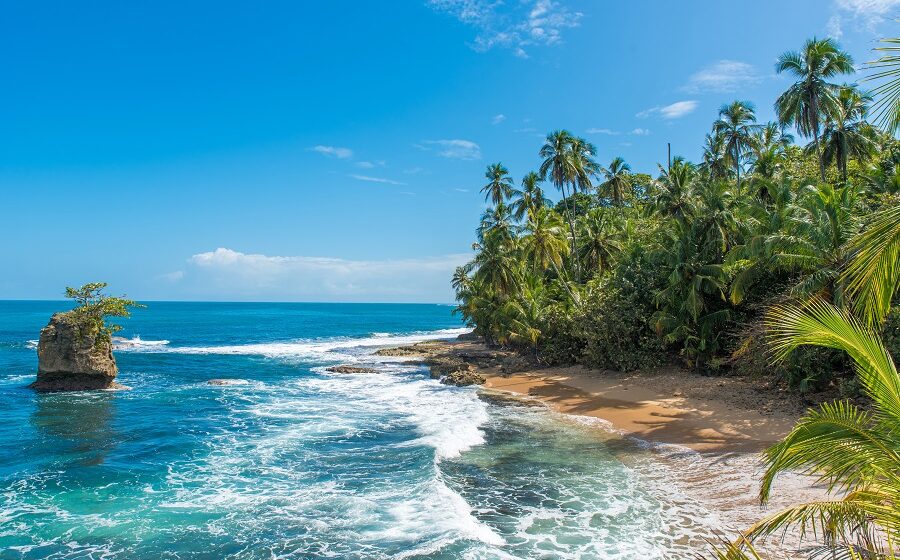
Beach vacations work well on both the Caribbean and Pacific coasts, sandy beaches framed by lush tropical greenery, some wild, some backed by excellent tourist infrastructure.
Certain beach areas are known for specific activities:
- Playa Flamingo, sport fishing
- Tamarindo, surfing
- Playa Grande, turtle watching
- Jacó, nightlife and music till dawn
Costa Rica’s beaches also come in a striking range of sand colors, white, silver, golden, and black. Playa Conchal is considered the whitest of them all.
Top Attractions
Most of Costa Rica’s landmarks are natural ones, and what’s listed here barely scratches the surface, the country’s 74 national parks and reserves, both public and private, cover a third of its territory. Among the best known: La Amistad, Manuel Antonio, Corcovado, Tortuguero, Rincón de la Vieja, and Monteverde.
There are historical sites too, including colonial-era landmarks scattered through San José and the countryside. For a glimpse of genuine Indigenous communities, La Amistad National Park is the country’s main hub for ethnographic tourism. Nearby sits the colorful town of Puerto Limón (often just called Limón), home to an ethnographic museum and a lively market, best visited on October 12 for its Columbus Day carnival.
Activities and Adventures
Costa Rica’s main draw is its huge range of excursions, from relaxed sightseeing to full-blown expeditions: helicopter tours, horseback rides, boat and yacht trips, and hot-air balloon flights.
Zip-lining is hugely popular here (by one account, it was invented in Costa Rica). Canopy tours, cable lines strung through the treetops, are another favorite, along with adrenaline-charged hanging bridge walks through the jungle canopy.
- River rafting through rushing, foam-flecked rapids framed by dense jungle
- Windsurfing, diving, snorkeling, and other water sports along the coast
- Fishing, especially strong near Playa Flamingo
- Windsurfing, diving, and fishing on Lake Arenal, near the volcano of the same name
- Water parks, the best known is the thermal park Baldi Hot Springs (Calambú) in La Fortuna
Cities have their own entertainment too: Spanish-style bullfights, cockfights, festivals, and celebrations, all bursting with color and energy.
Food and Drink
Costa Rican cuisine blends Spanish and Indigenous culinary traditions, built around rice, black beans, vegetables, and meat, brightened with spiced sauces.
Worth trying:
- Casado, rice, beans, and plantains served with meat or fish
- Gallo pinto, the classic breakfast rice-and-beans dish
- Ceviche
- Tamales
- Local coffee, chocolate, cacao, and the coffee liqueur Café Rica
Worth bringing home:
- Coffee and chocolate
- Handwoven textiles and crafts
- A traditional chorreador coffee maker
Getting Around
Buses and shared vans (colectivos) form the backbone of city and intercity transport. A tourist train also runs from San José to Caldera, San Pedro, and Pavas.
Buses are decent overall, though figuring out routes and stops can be tricky, windshields usually display a sign listing the main stops and fare. Informal stops are often marked only by a cluster of locals waiting or flagging down a bus, though proper stops with benches exist too.
Taxis can be hailed on the street or called by phone; a few local apps (Costa Rica Traveler, Yo Viajo, Moovit, Taxis Costa Rica, San Miguel) function more as directories of numbers and routes than as full-service ride apps. Official taxis are red with a yellow triangle logo, and fares run by meter.
Rental cars are available right at the airport, as well as at rental offices in San José, a Russian driver’s license is sufficient for the rental.
Safety and Practical Notes
Costa Rica is fairly stable by Latin American standards. Street crime exists, but police generally keep the situation under control, and traveling the country to see its natural sights is safe with ordinary precautions. The main issue visitors run into is theft, pickpockets favor tourist areas, and an unattended bag or camera can disappear in seconds.
Medical tourism is growing in Costa Rica, though it’s largely oriented toward US patients seeking treatment at up to 70% below US clinic prices; wellness centers for foreign retirees are also expanding, since many older Americans relocate to Costa Rica and neighboring Panama. The country recruits doctors trained in the US and Europe to maintain high standards of care, and travelers from Russia and Europe can tap into some of this too, pairing an adventure trip with a stop at a thalassotherapy or spa center for a more restorative edge.
Costa Rica’s natural wealth also draws poachers, so a number of customs restrictions are in place: it’s illegal to export rare animals or birds, including taxidermy, hides, or skulls, as well as antiques and archaeological artifacts.
Roughly half of Costa Ricans are Catholic and hold their religious sites in high regard; visitors are expected to show the same respect, avoid disrupting worshippers inside churches, and skip shorts or mini-skirts when visiting.
Staying Connected
Kolbi is the country’s most popular mobile carrier, with the widest coverage. Movistar and Claro don’t always match that signal in Guanacaste, but Movistar tends to offer better rates and faster mobile data.
A SIM card purchase usually comes preloaded with around 2,000 colones, though it’s worth topping up to about 5,000 colones for comfortable use of email, messaging apps, and YouTube. For heavier browsing or large file transfers, internet cafés (roughly 1,100 colones per hour) or free Wi-Fi are the better options.
Follow us on Facebook