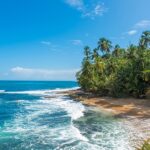
Know how many tourists visit Yemen’s remarkable island of Socotra? No more than a hundred a week, by the most optimistic count. Flights are scarce, and mostly carry locals.
A Quiet Island Far From the War
People here know about the war on Yemen’s mainland, but on the island itself it’s calm, and the conflict feels far away. The fighting is concentrated around Sanaa and Aden. Yemenis say the ruling clans are fighting each other, not ordinary people, but a war is still a war.
Socotra itself has never seen war. On the shore you can spot rusting T-34 tanks, gifts once sent over by the Soviet Union to defend against enemies. What enemies? Hard to say.
In the end, the tanks just sat there rotting at their posts. Photographing them isn’t allowed, but if you really want to, you can, as long as the soldiers at the nearby checkpoint don’t catch you. Otherwise they’ll make you delete every photo off your phone.
Yemen is an Islamic country, but there’s nothing to fear in that. Muslims, in my experience, are some of the most hospitable people you’ll meet. I’ve been to 157 countries, so I have plenty to compare against. Just respect local traditions and faith, and there won’t be any problems. Most Muslims are warm and welcoming, and on Socotra especially so. People here are peaceful and law-abiding. The island is small, everyone knows everyone’s business fast. There’s nowhere to run, and the laws are strict.
Socotra is a giant time machine: this is what our planet looked like a hundred million years ago.
From Pirates to Empty Beaches
Locals say the island once hosted pirate bases, but that “once” means the Middle Ages. Marco Polo wrote about it. Today there’s no trace of pirates, and no real tourist infrastructure either. You sleep in tents, use the sand dunes as a bathroom, wash at springs or from a basin, eat fish straight from the sea, wake at sunrise, watch sunsets from the coastal cliffs, and fall asleep to the sound of waves.
There are a couple of hotels in the capital, Hadibu, but they can’t compete with the untouched nature around them.
Socotra’s population is estimated at 40,000 to 50,000. No one knows the exact figure since there’s no recent official data.
Daily Life on the Island
The islanders are calm and hospitable, and crime is essentially nonexistent, same as alcohol. If customs finds a bottle on arrival, they confiscate it. I asked locals what happens to it, and they laughed, saying the customs officers probably drink it themselves in secret. Alcohol is fully banned, but everyone chews khat. My driver started first thing in the morning and by evening was in a state of giddy exaltation.
Socotra feels like another planet, barely touched by people, aside from the dusty capital littered with plastic bags, though we won’t be spending much time there. What awaits are white desert beaches, strange monsoon dunes climbing up coastal cliffs, and a wild, primeval landscape.
Dragon’s Blood Trees and Living Fossils
Then there are the dragon’s blood trees, shaped like giant heads of broccoli. They covered the Earth back in the age of dinosaurs, but survive today only here, on Socotra.
In March, the island’s bottle trees, alien-looking and equally endemic, bloom pink.
- Dragon’s blood trees: broccoli-shaped survivors from the age of dinosaurs
- Bottle trees: bloom pink in March, found nowhere else
- Hundreds of plant species found only on Socotra
Getting There
I fly to Socotra from Cairo via Seiyun, home to a small international airport. Checking in for the flight, oddly no one checks for a Yemeni visa, or a PCR test either. We depart on schedule. It’s a night flight, and I doze off for a while.
“Look, Mecca’s down there,” a flight attendant says, shaking my shoulder. Far below, a brightly lit square. I glance down, nod, and drift back to sleep.
Dawn breaks as we approach Seiyun. Below, a plateau cut through with canyons. Yemen’s famous high-rise mudbrick towers flash past the window. We land smoothly. Everyone continuing on to Socotra is asked to leave the plane.
At the airport entrance, staff collect completed questionnaires about cold and flu symptoms and check every passenger’s temperature. In the waiting hall, they take our passports and lock the door, posting a guard outside. I walk to the window. A truck speeds past, a man in uniform gripping a mounted machine gun in the back. An airport employee appears out of nowhere, selling internet access for two dollars. It never loads. Eventually our passports come back.
About an hour later, we’re called for boarding.
Arrival and First Stop: Detwah Lagoon
The airport on Socotra is small and pretty chaotic, with almost no checks. If I wanted, I could probably just walk straight out and no one would notice, though that would cause trouble on the way back, so I wait while locals sort out their many bundles of goods. With the war ongoing, many supplies now reach local shops by air.
After some jostling, I meet up with local guides, load into a four-wheel drive, and we head to our first stop, Detwah Lagoon, where long sand dunes slide down the cliffs into a blue-green sea, seeming to slice it into pieces.
The island is small, so it’s just over an hour’s drive before we arrive. We set up camp. The scenery is stunning. We climb a cliff for a better view, then head down to the shore for a swim. The water is crystal clear, fish darting busily back and forth. Small rays sit still on the seabed, then dart away the moment you take a step closer.

The water is a welcome relief after the long drive. I climb out, collapse onto the white sand, and doze off almost instantly under the midday tropical sun. It feels like I’ve landed on another planet. Maybe it’s not just a feeling. Socotra really is another world.
A Living Relic
Along with the Galapagos and Hawaii, Socotra ranks among the three places on Earth with the most unique, endemic nature. When a group of European scientists landed on the island in 1880, they identified more than two hundred previously unknown plant species in just two weeks.
The most famous are the dragon’s blood trees found in the island’s central region. They grew across the Earth as far back as the Cretaceous period, 145 to 66 million years ago, before going extinct elsewhere, mainly as ancient continents sank beneath the sea.
Socotra was never submerged, which is why these trees, along with other endemic species, survived here against all odds. In that sense, Socotra really is a giant time machine, a living glimpse of what our planet looked like a hundred million years ago.
Follow us on Facebook