Kyrgyzstan does not advertise itself much, and that is part of the appeal. This is a small, mountainous country in Central Asia where more than ninety percent of the land sits above 1,500 meters, and where a lake at 3,000 meters can still surprise you with how blue it gets. If the Alps feel like a theme park these days, Kyrgyzstan is the older, quieter cousin nobody bothered to fence off.
Why Kyrgyzstan, Not the Alps
The comparison isn’t really fair to either place, but it’s the one people ask about. The Alps have better infrastructure, more Michelin stars, and a lift to nearly every summit. Kyrgyzstan has almost none of that, and instead offers:
- Multi-day horseback routes through valleys with no other tourists in sight
- Yurt stays with nomadic families instead of alpine chalets
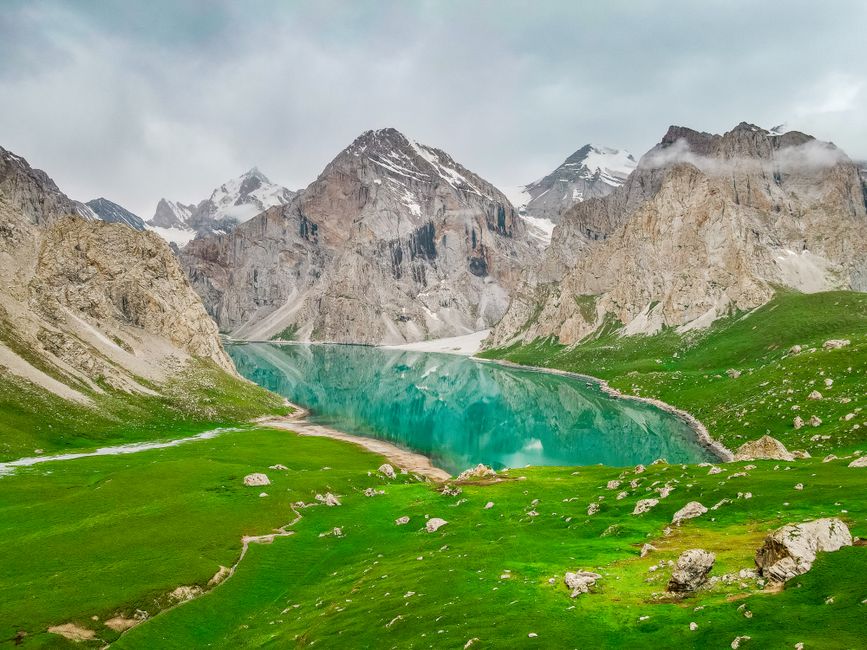
- Alpine lakes like Song Kul and Kel Suu that are barely developed
- A cost of living that makes a two week trip cheaper than a long weekend in Chamonix

Getting Around and Where to Go
Bishkek, the capital, is the usual entry point and a good place to arrange permits, guides, and gear before heading into the mountains. From there, most travelers fan out toward a handful of anchor destinations.
Song Kul Lake
A high altitude lake surrounded by open pasture, reachable by jeep or on horseback over a mountain pass. In summer, herding families set up yurt camps along the shore, and many take in guests for the night. There is no town here, no wifi, just grass, horses, and water that turns silver at dusk.
Karakol and the Central Tian Shan
Karakol is a low key base town near the eastern end of Issyk Kul, Kyrgyzstan’s enormous alpine lake, and the jumping off point for treks into the central Tian Shan range, including views toward Khan Tengri.
Kel Suu
Far closer to the Chinese border, this lake requires a border zone permit and more effort to reach, which is exactly why it stays empty. Locals sometimes describe it as the country’s best kept secret, and for once the cliche fits.
“We don’t count tourists here, we count horses,” a herder near Song Kul told a group of visitors a few summers back, half joking about how few travelers make it that far.
Horseback Travel
This is the country’s real specialty. Multi-day horse treks are widely available, from gentle half-day rides to week-long crossings between valleys, usually arranged through community-based tourism networks or local guesthouses (CBT Kyrgyzstan is the most established of these). No prior riding experience is required for most routes, though anyone with back or joint issues should ask about daily riding hours before booking.


Food
Kyrgyz food is hearty, meat forward, and built for cold nights at altitude. Expect:
- Plov, a rice and meat dish cooked in a single large pot, often shared
- Beshbarmak, boiled meat and flat noodles, traditionally eaten by hand
- Kymyz, fermented mare’s milk, an acquired taste that locals take pride in offering guests
- Fresh bread, or nan, baked in a tandoor and served with nearly every meal
- Manty, steamed dumplings usually filled with lamb or pumpkin
Vegetarians will find it harder going in rural areas, though cities like Bishkek and Karakol have more variety, including good options along the Dungan food tradition brought by an ethnic minority with roots in western China.
Prices
Kyrgyzstan remains one of the more affordable countries in Central Asia for travelers.
- A yurt stay with dinner and breakfast typically runs in the range of ten to twenty US dollars per person
- A simple guesthouse room in Bishkek or Karakol costs roughly fifteen to thirty dollars a night
- A hearty meal at a local cafe rarely exceeds five dollars
- Multi-day horse treks with a guide and pack horse support are priced per day and vary by route length and season, so it pays to compare a few CBT or guesthouse operators before booking
Cash is still king outside the capital, so carrying som (the local currency) in smaller denominations is wise once you leave Bishkek.
Public Safety
Kyrgyzstan is generally considered safe for travelers, including solo travelers, with petty crime being the main concern in cities rather than violent crime. That said, a few practical points matter more here than in Western Europe:
- Mountain regions have limited cell coverage and no rescue infrastructure comparable to the Alps, so travel with a guide or experienced local operator for anything beyond day hikes
- Border zones near China and Tajikistan require permits, and unauthorized entry into these areas can lead to serious trouble with border guards
- Road conditions in rural areas are rough, and mountain passes can close suddenly with weather, so build slack into any itinerary
- Political demonstrations occasionally occur in Bishkek, and travelers should simply avoid them rather than observe, as is generally sound advice anywhere
Practical Notes for Planning
- Best travel season is June through September, when high passes and yurt camps are accessible
- Bring layers regardless of season, since nights at altitude stay cold even in summer
- Basic Russian or Kyrgyz phrases go a long way outside tourist areas, since English is not widely spoken
- Community-based tourism offices in Karakol, Kochkor, and Naryn are reliable starting points for arranging treks, yurt stays, and transport
The Takeaway
Kyrgyzstan won’t hand you polished trailheads or mountain huts with wifi. What it offers instead is space, real nomadic culture that hasn’t been repackaged for tour buses, and mountains that feel genuinely enormous because there is nothing built up to compete with them. For travelers tired of sharing a summit photo with fifty strangers, that trade is an easy one to make.
Follow us on Facebook